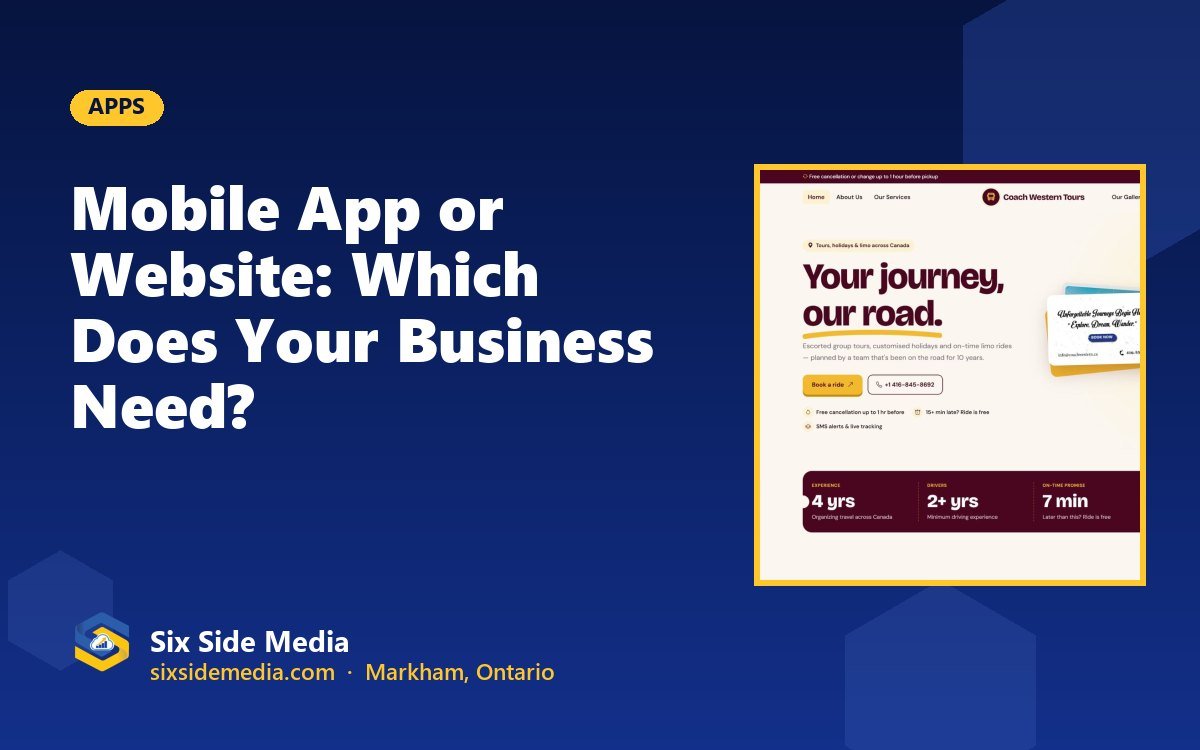
"Should we build an app?" is a question we hear from many growing businesses. Sometimes the answer is yes. Often, a great website or web app does the job faster and for less. Here's how to decide.
The key difference
A website opens in any browser, on any device, with no download. A mobile app is installed from the App Store or Google Play and lives on the customer's phone.
| Website / web app | Mobile app | |
|---|---|---|
| Reach | Anyone with a browser, found on Google | Only people who download it |
| Cost to launch | Lower | Higher (iPhone + Android) |
| Time to launch | Days to weeks | Weeks to months |
| Updates | Instant for everyone | Through app store releases |
| Phone features | Some (location, camera, payments) | Full (push notifications, offline, sensors) |
| Best for | Getting found and winning new customers | Frequent, repeat use by loyal customers |
When a website is the right choice
- You need new customers to find you on Google.
- Customers visit occasionally, for example to book a service or check a menu.
- You want to launch quickly and keep costs predictable.
- Your features are bookings, orders, payments, quotes or a customer portal, all of which work well on the web.
For most small and medium businesses, a fast, mobile-friendly website is the foundation. You can always add an app later.
When a mobile app makes sense
- Frequent use: customers order, book or check in several times a month (food ordering, laundry pickup, fitness, loyalty programs).
- Push notifications are important to bring people back.
- Phone features like GPS tracking, camera scanning, or offline access are core to the service.
- The app is the product, for example a booking marketplace or a delivery service.
- Internal teams need a tool in the field, like drivers or technicians.
The smart path: website first, app when it pays off
- Launch a strong website so customers can find you and do business online.
- Watch how customers use it. Are they coming back often? On which features?
- Build an app for your most loyal users once repeat usage justifies it.
- Share one backend so your website and app use the same data, saving cost.
Native, cross-platform or web app?
- Native apps (separate iPhone and Android builds) give the best performance and full device access.
- Cross-platform apps share one codebase for both platforms, often lowering cost and time.
- Web apps run in the browser and can be added to the home screen, with no app store needed.
We build all three, and we'll recommend the one that fits your users and budget. Learn more about our mobile app development and custom software services.
Frequently asked questions
Is a mobile app more expensive than a website?
Usually, yes. An app needs design for different screens, development for iPhone and Android (or a cross-platform build), app store publishing and ongoing updates. A website is typically faster and cheaper to launch.
Can a website work like an app?
Yes. A modern responsive website or web app can offer logins, bookings, payments and dashboards in the browser, with no download needed. For many businesses this is the best first step.
When should a business build a mobile app?
When customers use your service often (several times a month or more), when you need phone features like push notifications, GPS, camera or offline use, or when an app is the product itself.
Do you build both apps and websites?
Yes. Six Side Media builds websites, web apps, native iPhone and Android apps and cross-platform apps, and we'll recommend the right option after a free consultation.
Six Side Media is a Markham-based team with 12+ years of experience helping businesses across Toronto and Canada grow online. Get a free consultation and a clear plan for your project.